Railway Way Finding
A wayfinding system redesign for Indian Railways — simplifying navigation for millions of daily commuters through better signage and digital interfaces.
View on Behance ↗Railway Wayfinding transforms overwhelming station environments into intuitive, human-centred journeys.
Indian Railways is one of the world's largest railway networks — a lifeblood for over a billion people. Yet for the average commuter, navigating a busy station feels chaotic and stressful. This project is a comprehensive wayfinding system redesign: replacing unclear, inconsistent signage with a rigorous information hierarchy, a clear typographic system, and bold visual language that works across languages, literacy levels, and peak-hour crowds.
Research Context
Indian Railways carries 23 million passengers daily across 7,325 stations. Despite this scale, wayfinding signage varies wildly station to station — inconsistent typefaces, no colour coding, poor multilingual support, and signs placed too high or too far from decision points. The result: confusion, missed trains, and a deeply stressful commute.
Evidence Mapping is a visual way to organize research and highlight key patterns. In our project, we're using it to show how poor wayfinding in railway stations impacts people — from confusion and missed trains to accessibility failures. It helps us clearly present the evidence behind why better signage and navigation design truly matter.
Stampede at New Delhi station due to rapid announcements of three trains on unclear platforms. Overcrowding and poor communication about departure platforms led to the tragedy — passengers rushed simultaneously toward multiple platforms, creating chaos and panic.
Family missed train at Ghaziabad due to wrong platform info and lack of announcements. Consumer Forum ruled Railways failed to provide accurate, visible information and ordered Rs 1,000 compensation.
India's railway network serves 22 million daily passengers, but poor first/last mile connectivity persists — badly designed drop-off zones, encroached walking spaces, unclear signage, and unsafe crossings compound station navigation failures.
Central Railway's coach layout overhaul caused widespread confusion with mismatched berth assignments. Passengers struggled to locate correct seats due to unclear information about new coach positions, resulting in significant chaos at stations.
Delayed arrival of two Danapur-bound trains during Diwali rush sparked panic due to inadequate communication. Passengers boarded wrong trains, forcing railway staff and RPF to intervene for nearly an hour.
Passengers at Hubballi faced confusion and missed connections due to multi-destination boards displaying several train numbers on the same coach. Lack of clear announcements led travelers to board wrong trains.
Accessibility audit of nine redeveloped Tamil Nadu stations revealed critical gaps: locked accessible toilets, missing Braille signs, inadequate ramps, and poor wheelchair availability. Deficiencies persist despite legal mandates.
Technical issues rendered Platform 6's information display board at Pune Railway Station inoperative for several days, leaving passengers unable to check arrivals and departures during peak hours.
Railway Board directed zones to act against officials responsible for incorrect passenger information system data. Board ordered urgent replacement of outdated systems causing traveler confusion across the network.
Station Comparison
Comparing CSMT (the gold standard) with Kalupur reveals critical gaps in wayfinding implementation across Indian railway stations. CSMT's success in navigation design serves as a benchmark to identify what's missing at Kalupur — highlighting specific failures in signage, accessibility, and passenger information systems that need urgent improvement.
We visited Kalupur Station, Sabarmati Station, and Asarva Station in Ahmedabad for our research purposes. These key railway stations provided insights into station layout, passenger flow, wayfinding challenges, and infrastructural facilities essential for our study on the Indian railway system.
7. Contextual Inquiry
Contextual Inquiry observes passengers navigating stations in real-time to understand actual wayfinding challenges. By studying how people interpret signage and move through spaces, we uncover genuine problems that surveys alone would miss — revealing true pain points and design opportunities.
Peak Chaos Patterns
Peak chaos occurs during morning time and holiday periods, especially Diwali, when Kalupur's footfall surges from 5,000 to 20–25,000 passengers. Migrant workers traveling to UP and Bihar overwhelm the station, causing mass confusion as inadequate wayfinding systems fail under crowd pressure when clear navigation is most critical.
- Cannot tell which platform goes to which destination — signs are too small and too high
- Multilingual boards switch languages every 3 seconds, causing missed information
- No clear directional cues at exits — ended up on the wrong side of the station twice
- Quickly identify the correct platform without asking anyone
- Understand signage in her preferred language (Hindi/Gujarati) at a glance
- Know exactly where to walk — no dead-ends or doubling back
- Peak hour crowds make it impossible to read overhead signs from a distance
- Emergency evacuation routes are unmarked — relies on memory after an incident last year
- New digital boards show too much information at once; prefers simple colour-coded cues
- Navigate peak-hour platforms in under 90 seconds
- Rely on colour and shape cues rather than reading full sign text
- Find the emergency exit closest to his usual boarding point quickly
- Search train timings online
- Book ticket (online/offline)
- Check platform information
- Enter station premises
- Look for entry gate
- Navigate through security
- Search for platform number
- Check information displays
- Ask station staff for help
- Navigate stairs/lifts/ramps
- Cross to correct platform
- Locate waiting area
- Find correct coach position
- Verify train number
- Locate berth/seat
- Add station map to ticket
- Include platform location details
- Provide digital wayfinding link
- Clear directional signage at entries
- Platform-wise entry guidance
- Visible station layout boards
- Real-time digital displays
- Clear audio announcements
- Platform-specific color coding
- Mobile app integration
- Multi-level wayfinding signage
- Crowd management systems
- Dedicated accessible routes
- Real-time crowd alerts
- Coach-specific platform markings
- Digital coach position indicators
- Mobile alerts for changes
- Clear train identification boards
Platform Color Code
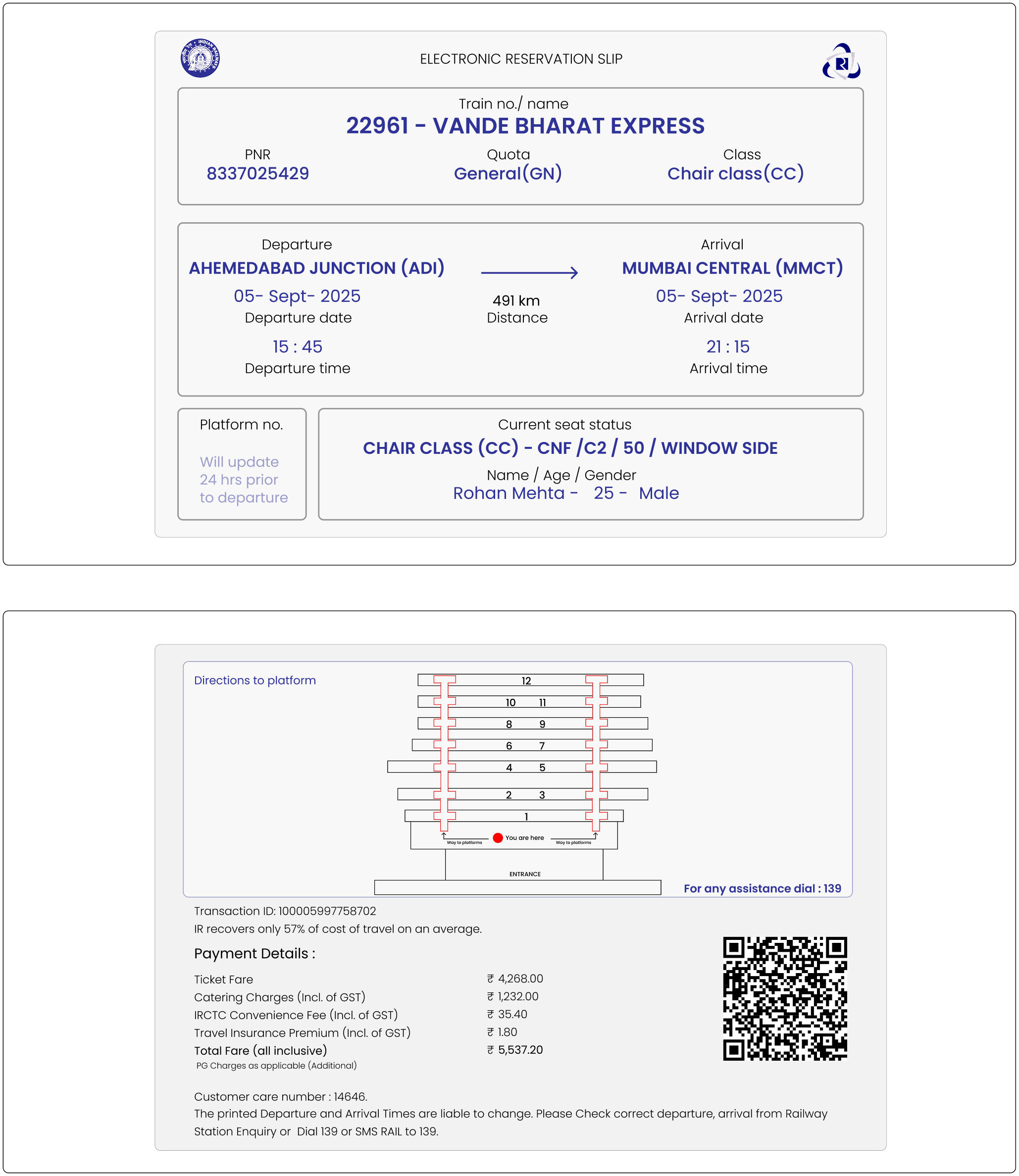
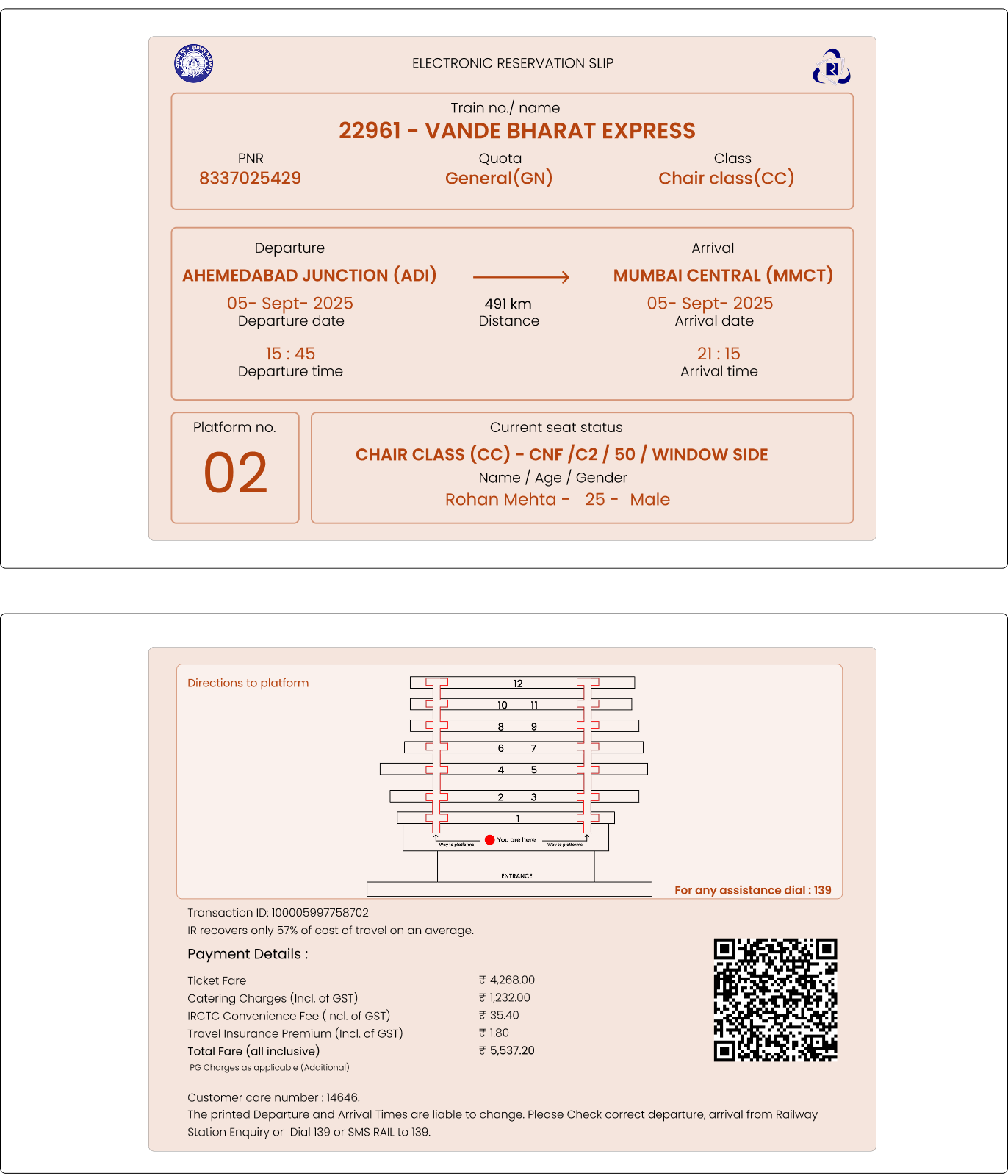
Our solution involves redesigning railway tickets — both online and offline — to display clear, essential information including precise station location details and platform colour codes. This ensures passengers have reliable wayfinding guidance directly on their tickets, reducing confusion and improving navigation from the moment they plan their journey.
Each platform is assigned a distinct colour — visible on tickets, overhead signs, and digital displays — so passengers know exactly where to go before they even enter the station.